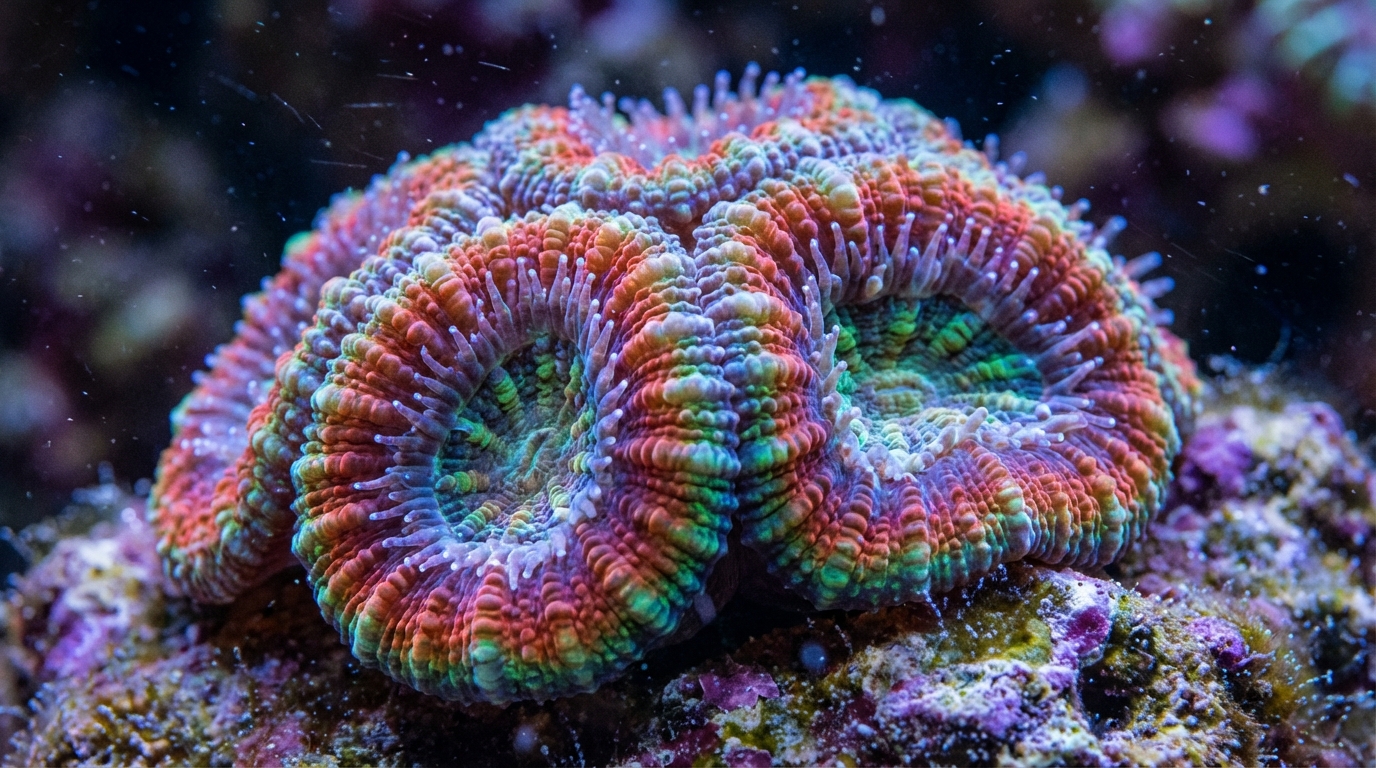
Acan coral (Micromussa lordhowensis, commonly still called "Acan Lords") remains one of the highest-conversion LPS corals for reef keepers because it offers bright color, visible feeding response, and manageable placement requirements. The catch is that many hobbyists lose color or experience slow tissue recession from avoidable mistakes: unstable alkalinity, excessive light jumps, poor feeding strategy, or aggressive neighbors with long sweepers. This 2026 care guide gives a practical, buyer-intent playbook you can actually run in a real mixed reef.
If you are sourcing frags, compare current options in the ReefBay shop, then cross-check potential placement neighbors like hammer coral and torch coral before final placement. For stability tracking and feeding logs, use the ReefBay app to tie parameter trends to growth and color outcomes.
Why Acan coral performs so well in mixed reefs
Acan coral is popular because it can thrive under moderate light and moderate flow while still delivering premium visual impact. It also provides clear feedback: inflated tissue, feeding tentacle extension, and polyp fullness tell you whether husbandry is working. Compared with many SPS corals, Acans are less demanding about ultra-low nutrients and can remain healthy in balanced, nutrient-present systems.
- Common name: Acan coral / Acan Lord
- Type: LPS (large-polyp stony coral)
- Difficulty: Beginner-to-intermediate
- Growth pattern: Encrusting colony with fleshy polyps
- Best fit: Mixed reefs seeking color and feeding interaction
Tank prerequisites before adding Acans
You can keep Acans in mature nano and larger systems, but maturity and consistency matter more than gallon count alone. Before purchase, confirm your tank has predictable temperature, salinity, and alkalinity trends across at least 2-4 weeks.
- Nano systems (20-40g): Works well with disciplined top-off and dosing.
- 40-75g mixed reef: Excellent control window for beginners.
- 75g+ systems: More placement flexibility, easier aggression spacing.
Do not add Acans into a tank still showing nitrogen-cycle instability or repeated alkalinity swings. A visually "clear" tank can still be chemically unstable.
Parameter targets for growth, color, and tissue health
Acans tolerate a useful range, but they punish inconsistency. Focus on trend control rather than chasing a perfect single reading.
- Temperature: 76-79°F (24.4-26.1°C)
- Salinity: 1.025-1.026 SG
- Alkalinity: 8.0-9.0 dKH with minimal day-to-day swing
- Calcium: 400-450 ppm
- Magnesium: 1250-1400 ppm
- Nitrate: 5-20 ppm
- Phosphate: 0.03-0.10 ppm
- pH: 8.0-8.4
Use the ReefBay app to track weekly parameter trends alongside coral response photos. In practice, this correlation is what helps you intervene early before recession spreads.
Lighting: PAR targets and acclimation that prevent bleaching
Acan coral generally performs best in lower-to-mid PAR zones. Many losses happen when reefers move new frags directly under intense LED hotspots.
- Target PAR range: 50-120 for most systems
- Sweet spot for many colonies: 70-100 PAR
- Acclimation: Start lower, ramp over 10-21 days
If you recently upgraded lights, reduce intensity or use shading screens during transition. Color fade, tissue contraction, and delayed feeding response are early stress signals. Slow transitions outperform aggressive light ramps almost every time with Acan.
Flow placement: enough movement without tissue damage
Acans want gentle-to-moderate indirect flow. Direct jets can strip tissue and prevent extension. Dead zones, however, increase detritus buildup and infection risk.
Placement checklist
- Choose a zone with visible but soft tissue movement.
- Avoid direct pump line at polyp level.
- Keep colony slightly elevated from detritus traps when possible.
- Re-check flow pattern after coral growth changes nearby.
Feeding strategy for faster growth and better recovery
Acan coral can survive on photosynthesis and ambient nutrients, but targeted feeding usually improves growth, inflation, and recovery from stress. Feed small, digestible foods when tentacles are active.
- Frequency: 2-4 times per week for growth-focused tanks
- Food types: Mysis, fine reef blends, LPS pellets, amino-supported foods
- Timing: Lower flow temporarily, feed after lights dim or during extension
- Portion: Small enough to avoid excess nutrient spikes
After feeding, restore flow gradually so food is not blown off polyps immediately. Keep nutrient export balanced with your feeding intensity.
Aggression and spacing: avoiding sweeper damage
Acans are not the most aggressive LPS, but they can be damaged by neighbors with long sweepers. Torch, hammer, and some euphyllia species frequently cause nighttime stings if spacing is too tight.
- Leave conservative buffer zones between LPS colonies.
- Inspect after lights-out at least once weekly during first month.
- Account for future growth, not just current frag size.
- Do not trust daytime peace as proof of nighttime safety.
When planning a new layout, compare options in acan listings and neighboring coral categories like euphyllia to avoid incompatible spacing decisions.
Quarantine and dipping approach for pest prevention
Acan frags can carry hitchhikers and bacterial risks like any imported coral. A basic intake protocol dramatically reduces avoidable losses.
- Visually inspect skeleton edges and tissue for recession.
- Dip with reef-safe coral dip following label instructions.
- Rinse in clean saltwater before display placement.
- Optional observation rack period before permanent placement.
- Photograph baseline tissue condition on day one.
For supplies, source dip and tools through shop coral gear so you can keep a repeatable intake workflow.
First 90 days: practical operating plan
Days 1-14: settle and observe
- Keep PAR conservative and flow indirect.
- Avoid moving the frag repeatedly.
- Feed lightly once extension is visible.
- Track response in the ReefBay app.
Days 15-45: tune for growth
- Increase feeding frequency if nutrients remain in range.
- Fine-tune placement for inflation and color saturation.
- Stabilize alkalinity dosing cadence.
Days 46-90: lock in consistency
- Maintain weekly trend checks for alk/cal/mag.
- Re-evaluate neighbor spacing as tissue expands.
- Set a photo log interval for objective comparison.
Troubleshooting common Acan problems
Problem: tissue recession from edges
Likely causes: alkalinity instability, pest irritation, flow abrasion, bacterial pressure. Actions: stabilize alk first, inspect for pests, reduce direct flow, and isolate if needed.
Problem: color fade or dulling
Likely causes: excessive PAR jump, nutrient starvation, chronic stress. Actions: lower light intensity, confirm nitrate/phosphate are not bottomed out, improve feeding consistency.
Problem: no feeding response
Likely causes: stress from transport, flow too high during feeding, overbright placement. Actions: lower flow during feeding window, try smaller foods, allow additional acclimation days.
Problem: sudden nighttime damage
Likely causes: sweeper contact from nearby LPS. Actions: increase spacing and run a nighttime inspection pass.
Fragging and propagation notes
Healthy colonies can be fragged, but do not frag stressed or recently imported pieces. Use clean tools, controlled cuts between polyp mouths, and a stable recovery environment with moderate flow and conservative light. Growth is usually faster in stable nutrient systems with consistent feeding and minimal parameter swings.
Buying checklist: choose better frags from day one
- Polyp tissue should be full and attached cleanly to skeleton.
- No exposed skeleton progression at frag edges.
- Color should look natural, not only camera-saturated.
- Seller photos should show multiple angles when possible.
- Prefer frags already adapted to reef LED environments.
Use the ReefBay marketplace to compare specimens and seller quality before buying. Better specimen selection lowers risk more than any emergency intervention later.
Advanced nutrient management for color retention
Acan coloration often improves in tanks that run "clean but not sterile." Ultra-low nutrient systems can look polished but still underfeed fleshy LPS corals over time. The operational goal is controlled nutrients with strong export discipline, not zero nutrients.
- Keep nitrate and phosphate detectable and stable.
- Avoid aggressive media changes that strip nutrients overnight.
- Match feeding increases with predictable export adjustments.
- Use trend charts instead of reacting to one isolated test.
If you see pale tissue plus weak extension, investigate whether nutrient suppression is excessive before making major lighting changes.
Dosing strategy that supports LPS stability
As colonies grow, alkalinity and calcium demand rises. Waiting until parameters drift creates a reactive cycle that Acans dislike. A basic dosing structure keeps growth predictable.
- Test alk at the same time each day for one week.
- Estimate daily consumption and begin conservative dosing.
- Re-test every 2-3 days until trend is flat.
- Adjust in small increments instead of large corrections.
- Re-baseline after adding major new stony coral biomass.
Document dose changes and coral response in the ReefBay app so you can identify your tank's true demand curve.
Placement by tank zone: practical map
Instead of guessing, assign placement zones before introducing new frags:
- Zone A (lower PAR, lower flow): new or stressed Acans
- Zone B (mid PAR, indirect flow): established colonies and growth focus
- Zone C (higher PAR edge): only for acclimated pieces with proven tolerance
This zoning model prevents repeated movement, which is a hidden stress multiplier in many mixed reefs.
Photography and objective growth tracking
Human memory is poor for subtle coral change. Monthly photos from the same angle and exposure settings create objective evidence. Track three metrics: polyp fullness, edge encrustation, and color saturation. If two metrics decline, intervene quickly instead of waiting for obvious recession.
Use consistent timestamps and attach notes (feeding change, light adjustment, new neighbor coral) in your log entries. This transforms your husbandry from intuition to repeatable operations.
Emergency response plan for recession events
When recession appears, speed and sequence matter. Use this order:
- Confirm alkalinity and salinity immediately.
- Check for direct flow abrasion and sweeper contact.
- Inspect for pests or tissue damage points.
- Move to a lower-stress holding zone if needed.
- Stabilize, then resume cautious feeding once tissue settles.
Avoid "shotgun fixes" where multiple variables change at once. Controlled troubleshooting preserves diagnostic clarity and improves save rates.
Building a resilient mixed-reef coral plan
Acan success improves when coral selection is planned as a compatibility portfolio rather than random additions. Mix corals by growth style, aggression profile, and flow preference. This reduces warfare and maintenance complexity.
- Pair Acans with moderate neighbors that do not cast long sweepers.
- Reserve high-aggression LPS for isolated islands.
- Leave expansion room for 6-12 months of growth.
- Use sandbed or lower rock shelves for easy access and feeding.
When expanding inventory, review compatible options in micromussa, favia, and zoa categories before checkout.
Weekly and monthly maintenance checklist
Acans respond best when maintenance is boring and repeatable. Use this simple checklist to keep outcomes stable even when life gets busy.
Weekly checklist
- Verify temperature and salinity stability.
- Test alkalinity and compare to previous week.
- Inspect tissue inflation before and after feeding.
- Check for detritus pockets around colony base.
- Confirm no new contact risk from neighboring corals.
Monthly checklist
- Update growth photos from fixed camera angle.
- Review nitrate/phosphate trend over full month.
- Audit dosing consistency and refill supplies.
- Re-evaluate placement as colonies expand.
- Log wins and setbacks in the ReefBay app.
Consistency at this cadence prevents most emergency interventions and supports steady color development.
Long-term success framework
Acan coral rewards consistency, not constant tinkering. If your tank has stable alkalinity, moderate nutrients, proper spacing, and a repeatable feeding rhythm, Acans can become one of the most dependable and photogenic LPS groups in a mixed reef. Most failures are system-management errors, not "difficult coral" problems.
Think in systems: every decision around light, flow, feeding, and nutrient export should reinforce the same goal-stable tissue health with controlled growth. When in doubt, choose the less aggressive adjustment and verify results over 7-14 days. That slower cadence preserves coral resilience and makes your tank easier to manage at scale as your collection grows.
Ready to add one? Browse live Acan listings, evaluate compatible neighbors in zoa and blasto categories, and track your first 90 days with the ReefBay app so each husbandry change is evidence-based.
Small, consistent improvements beat dramatic overhauls. Keep your process tight, and Acans will reward you with long-term color, growth, and visual impact. Build your system around repeatable routines, clear notes, and early intervention, and you will spend more time enjoying coral expansion than firefighting preventable setbacks, especially during your first year scaling a serious mixed reef collection over time with confidence daily.