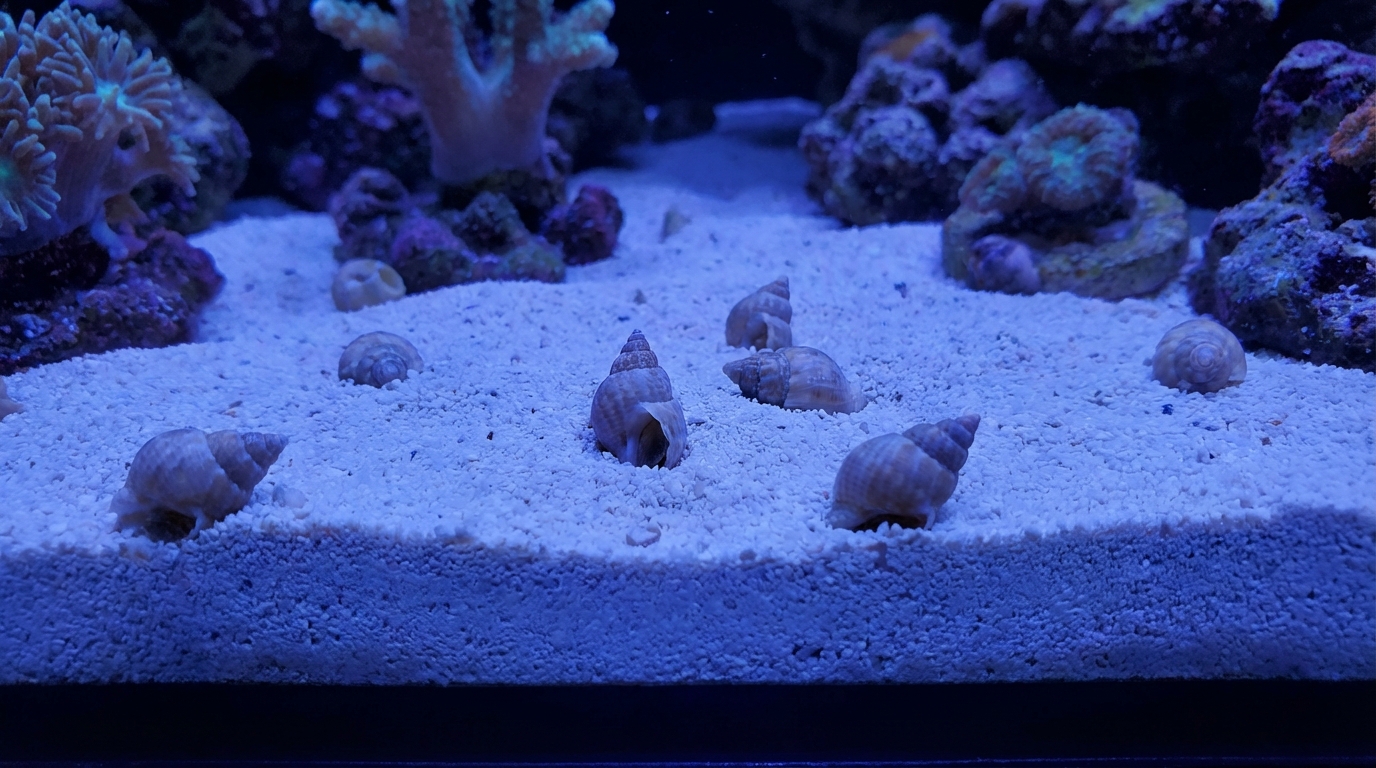
Nassarius snails are the unsung heroes of the reef tank clean up crew. These small, active scavengers spend their time buried in your sand bed, emerging at the first hint of food to clean up detritus and uneaten meals. For anyone with a sand bottom, they're an essential addition.
Nassarius Snail Quick Facts
- Scientific Name: Nassarius sp.
- Common Names: Nassarius snail, nass snail, super tongan nassarius
- Size: 0.5-1 inch
- Lifespan: 2-3 years with good care
- Diet: Scavenger (detritus, uneaten food, carrion)
- Reef Safe: Yes - completely safe
- Care Level: Easy
Why Every Sand Bed Needs Nassarius Snails
Nassarius snails provide several critical benefits for reef tanks with sand substrates:
Sand Bed Aeration
As nassarius snails burrow through your substrate, they prevent dead spots and anaerobic pockets from forming. This constant stirring keeps your sand bed healthy and prevents hydrogen sulfide buildup that can harm your tank.
Detritus Removal
These snails are incredibly efficient at finding and consuming organic waste that settles into the sand. They detect food from remarkable distances and will "swarm" feeding areas within minutes.
Carrion Cleanup
If a fish or invert dies in your tank, nassarius snails are often the first to find it. They help prevent dead animals from fouling your water by consuming them quickly.
Entertainment Value
Watching nassarius snails emerge from the sand at feeding time is genuinely entertaining. Their long siphons appear first, "sniffing" the water, followed by rapid movement toward food.
Ideal Tank Conditions
Water Parameters
- Temperature: 72-78°F
- Salinity: 1.023-1.025
- pH: 8.1-8.4
- Calcium: 350-450 ppm
- Alkalinity: 8-12 dKH
- Magnesium: 1250-1350 ppm
Tank Requirements
- Substrate: Sand bed required (1-2 inches minimum)
- Minimum tank size: Any (they adapt to tank size)
- Flow: Any - they stay in the sand
- Lighting: Not relevant - they're nocturnal/buried
How Many Nassarius Snails Do You Need?
The general recommendation is 1 nassarius snail per 2-5 gallons of tank volume with a sand bed. However, this depends on several factors:
- Feeding habits: Heavy feeders need more snails
- Sand bed depth: Deeper beds can support more snails
- Other CUC members: Factor in your hermits and other snails
Suggested Stocking
- 20-gallon tank: 4-10 nassarius snails
- 40-gallon tank: 8-20 nassarius snails
- 75-gallon tank: 15-35 nassarius snails
- 120-gallon tank: 25-50 nassarius snails
Start with fewer and add more if needed. You'll know you have too few if uneaten food sits in the sand for extended periods.
Feeding Nassarius Snails
Nassarius snails are scavengers that thrive on leftovers. In most established tanks, they'll find enough food naturally:
- Uneaten fish food that sinks to the sand
- Detritus and organic waste
- Dead animals (they're often called "tank police" for finding casualties)
- Frozen foods like mysis and brine shrimp
Signs They're Not Getting Enough Food
- Shells appearing at the surface constantly (food-seeking behavior)
- Decreased activity and movement
- Dying snails despite good water quality
If your tank is too "clean" (very light fish load), you may need to target feed occasionally. Drop a piece of frozen food near the sand and watch them swarm.
Common Species
Super Tongan Nassarius (Nassarius distortus)
The most popular species in the hobby. These are larger, more active, and incredibly efficient. They're the ones most commonly sold as "nassarius snails" in the trade.
Regular Nassarius (Nassarius vibex)
Smaller than Tongans but equally useful. Often more affordable and still excellent sand stirrers.
Olive Nerite/Nassarius (Nassarius obsoletus)
Sometimes confused with nassarius, but a different species. Still useful but less active as sand sifters.
Tank Mates and Compatibility
Nassarius snails are peaceful and get along with virtually everything in a reef tank:
Great Tank Mates
- Clownfish and other reef-safe fish
- Hermit crabs (though hermits may compete for shells)
- Other snails (cerith, trochus, turbos)
- All corals (completely reef safe)
- Shrimp (cleaner shrimp, peppermint shrimp)
Potential Issues
- Hermit crabs: May attack nassarius for their shells. Provide extra empty shells.
- Wrasses: Some wrasses dig through sand and may disturb snails, but rarely harm them.
- Sand-sifting fish: Gobies and sleeper gobies compete for the same detritus.
Acclimation
Like all invertebrates, nassarius snails are sensitive to rapid parameter changes:
- Float the bag for 15-20 minutes to equalize temperature
- Drip acclimate for 30-60 minutes (2-4 drips per second)
- Place gently on the sand - they'll burrow within minutes
- Never expose to air or pour bag water into your tank
Breeding
Nassarius snails do breed in captivity. You may notice small egg capsules on glass or rocks. However, the larvae require specific conditions and food (phytoplankton) to survive. Most hobbyists don't successfully raise the larvae, but it's not unusual to find occasional juveniles in established tanks.
Common Problems
Snails Dying Shortly After Introduction
Cause: Usually acclimation shock or copper exposure
Solution: Always drip acclimate. Check if your tank has been treated with copper medications (even trace amounts kill inverts).
Snails Always on the Surface
Cause: Poor water quality, low oxygen, or starvation
Solution: Test your water parameters. If everything checks out, try target feeding.
Empty Shells Appearing
Cause: Natural death, predation, or hermit crab attacks
Solution: Provide extra empty shells for hermits. Check for aggressive tank mates.
Where to Buy Nassarius Snails
Check the ReefBay marketplace for nassarius snails from verified sellers. Look for sellers who ship invertebrates with care and guarantee live arrival.
Final Thoughts
Nassarius snails are an essential part of any reef tank clean up crew with a sand substrate. They're hardy, easy to care for, and provide valuable sand bed maintenance that no other CUC member matches. Start with a reasonable number, ensure your tank has enough food to sustain them, and enjoy watching these entertaining little scavengers keep your sand pristine.
For the best results, combine nassarius with other CUC members like cerith snails (rock cleaners), trochus snails (algae control), and hermit crabs for a balanced clean up crew. Track your livestock with the ReefBay app to remember when you last added to your crew.