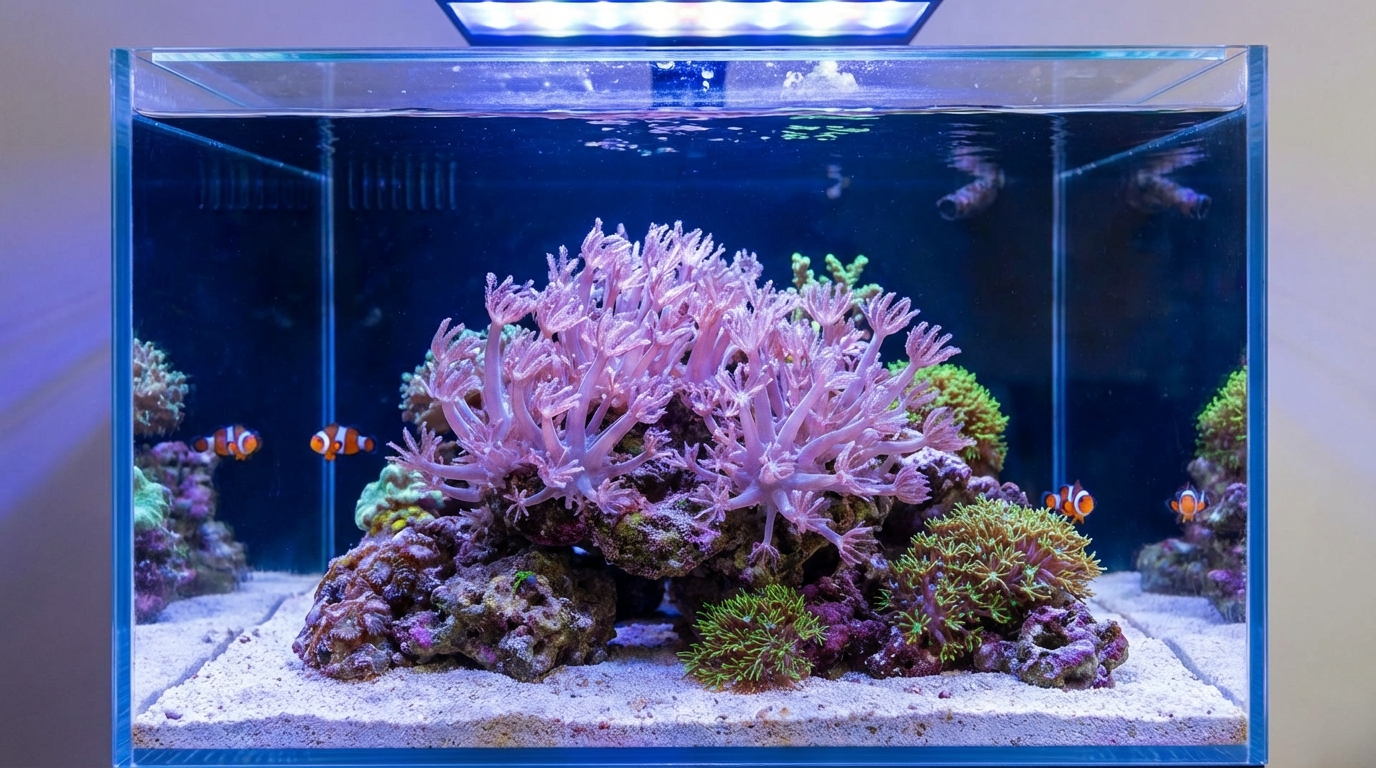
Pulsing xenia is one of the easiest soft corals for beginners, but it can crash from alkalinity swings and overtake rockwork fast if you do not plan placement early. This guide gives you the exact setup targets, flow and lighting ranges, and practical containment steps so you can keep xenia healthy without letting it dominate your reef.
What Makes Xenia Special?
Xenia (most commonly Xenia elongata) belongs to the family Xeniidae. What sets it apart from other soft corals is its distinctive pulsing behavior—the polyps rhythmically open and close their feathery tentacles. Scientists aren't entirely sure why xenia pulses, but theories include improved gas exchange and waste removal.
This hypnotic motion makes xenia a fascinating addition to any reef tank, especially for beginners who want to see immediate movement and life in their aquarium.
Common Xenia Varieties
- Pulsing Xenia (Xenia elongata) - The classic white/tan pulsing variety
- Pom Pom Xenia - Rounded polyp tips that pulse vigorously
- Red Sea Xenia - Often more colorful with pink/purple hues
- Silver Tip Xenia - Features silver-colored polyp tips
Water Parameters
Xenia is remarkably adaptable, but here are the optimal conditions:
- Temperature: 75-82°F (24-28°C)
- Salinity: 1.023-1.026 specific gravity
- pH: 8.1-8.4
- Alkalinity: 8-12 dKH (very important!)
- Calcium: 400-450 ppm
- Magnesium: 1250-1350 ppm
- Nitrate: 5-25 ppm
- Phosphate: 0.03-0.1 ppm
Critical Note: Xenia is particularly sensitive to alkalinity swings. Unstable dKH is the #1 cause of xenia melting. Keep your alkalinity stable above all else. Track your parameters regularly with the ReefBay app to catch fluctuations early.
Lighting Requirements
Xenia is very flexible with lighting:
- PAR Range: 50-150 (low to moderate)
- Light Type: Any reef-capable lighting works
- Acclimation: Start lower and raise if needed
In fact, xenia often grows faster under lower light conditions. High-intensity lighting isn't necessary and won't make your xenia pulse more actively.
Flow Requirements
Getting flow right enhances the pulsing display:
- Flow Level: Low to moderate, random/indirect
- Sweet Spot: Gentle enough for polyps to open, strong enough to prevent detritus buildup
- Watch For: Polyps blown flat (too much) or not fully extending (too little)
Xenia pulses best in calmer water. Direct, high flow from powerheads will stress the coral and reduce the pulsing behavior you want to see.
Why Does Xenia Stop Pulsing?
If your xenia stops its signature motion, check these factors:
- Alkalinity Crash: The most common cause. Test immediately.
- Recent Move: Xenia may stop pulsing for days after relocation.
- Too Much Flow: Reduce direct current hitting the colony.
- Water Quality: Test all parameters; perform a water change.
- New Tank Syndrome: Xenia may take weeks to settle in new systems.
Some xenia simply pulses less than others—it varies by individual colony and environmental conditions.
The Growth Problem (And How to Manage It)
Xenia's biggest "issue" is that it grows too well. Left unchecked, xenia can take over a tank, spreading across your rockwork and potentially smothering other corals.
Containment Strategies
- Island Rock: Place xenia on an isolated rock surrounded by sand—they can't easily spread across sand beds.
- Regular Pruning: Remove new stalks before they attach firmly. Use scissors or just pinch them off.
- Frag and Trade: Share your excess xenia with other reefers or trade at local clubs.
- Dedicated Section: Give xenia its own corner of the tank and prune the edges regularly.
Emergency Removal
If xenia has spread where you don't want it:
- Manually remove as much as possible
- Scrub attachment points with a toothbrush
- Apply kalkwasser paste to stubborn bases
- Monitor for regrowth and repeat as needed
Propagation
Fragging xenia couldn't be easier—they practically frag themselves:
- Cut a stalk with sharp scissors or a razor
- Place the frag in a low-flow area
- Let it attach naturally to rubble or a frag plug
- It will typically attach within 1-2 weeks
You can also let xenia naturally "walk" onto adjacent rocks and then remove that rock to create new colonies.
Common Problems
Xenia Melting
The dreaded "xenia melt" happens when colonies suddenly deteriorate into a pile of goo. Common causes:
- Alkalinity swings (most common)
- Salinity fluctuations
- Introduction of medications or treatments
- Bacterial infections
Act fast if you see melting: Remove dying tissue, increase water flow, and check all parameters. Sometimes isolating the affected colony helps.
Won't Attach
- Use rubber bands to secure frags temporarily
- Place in very low flow during attachment
- Give it time—some colonies take weeks
Losing Color
- Usually too much light—move lower or shade
- Could indicate parameter issues
- Normal after major changes; give it time to acclimate
Best Tankmates
Xenia plays well with most reef inhabitants:
- Mushroom corals
- Zoanthids
- Other soft corals (with spacing)
- Most reef-safe fish
- Most invertebrates
Be cautious with:
- Aggressive corals that might sting xenia
- Fish that eat soft corals (some angels, some filefish)
- Placing near valuable corals xenia might overgrow
Is Xenia Right for You?
Xenia is perfect if you:
- Want an easy, hardy coral that's virtually unkillable
- Love the pulsing motion and want movement in your tank
- Don't mind doing regular maintenance to control growth
- Have extra space or an island rock setup
Think twice if you:
- Have a small tank with limited space
- Prefer minimal maintenance reef keeping
- Already have an SPS-dominated display (allelopathy concerns)
Conclusion
Pulsing xenia is one of the most rewarding corals for reef keepers who appreciate motion and easy care. Its hypnotic rhythm adds life to any tank, and its hardiness means success for beginners. Just plan ahead for its enthusiastic growth, and you'll have a stunning coral that pulses happily for years.
Ready to add xenia to your tank? Browse xenia corals for sale on our marketplace, and use the ReefBay app to track your tank parameters and keep your coral thriving.
Shop Xenia-Friendly Additions
If you are planning a soft-coral section, browse xenia, zoa, and mushroom listings from verified ReefBay sellers. Then use the ReefBay app to track alkalinity stability week to week.