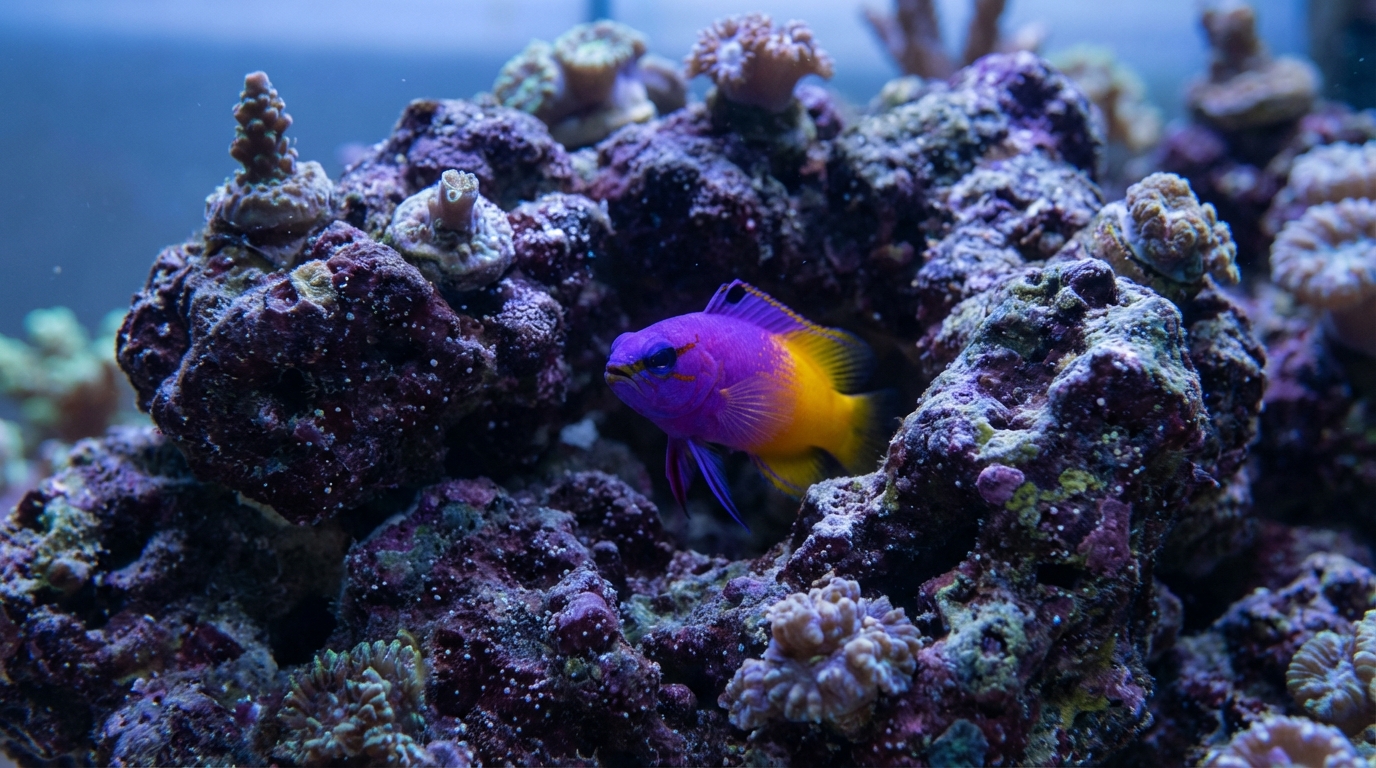
Royal gramma is one of the most practical saltwater fish choices for reef keepers who want color, personality, and manageable care. The challenge is that most care advice online is either too generic or leaves out the details that actually prevent stress, jumping, and feeding issues. This guide gives you a complete 2026 playbook for housing a Royal Gramma (Gramma loreto) in a stable reef system, including tank size, aquascape strategy, feeding schedule, compatibility decisions, quarantine options, and a troubleshooting plan for the first 90 days.
If you are still building your stocking list, start by browsing current livestock availability in the ReefBay shop and compare candidate tank mates in the goby category and clownfish category. As you dial in long-term stability, use the ReefBay app to log temperature, alkalinity, nitrate, and feeding notes so you can catch stress patterns early.
Quick profile: what makes Royal Gramma a high-value reef fish
Royal Gramma combines bright purple-to-yellow coloration with relatively peaceful behavior and low bioload. That makes it highly attractive for mixed reefs and for buyers who want visual impact without stepping into difficult species. The fish is cave-oriented, spends most of the day weaving in and out of rock structure, and tends to establish a small territory rather than roaming aggressively across the full tank.
- Scientific name: Gramma loreto
- Adult size: ~3 inches (7.5 cm)
- Temperament: Semi-peaceful, territorial around cave entrance
- Reef safety: Reef safe with corals and most invertebrates
- Difficulty: Beginner-to-intermediate
- Best use case: Community reef with defined rockwork zones
Minimum tank size and layout strategy
The common "30 gallon minimum" recommendation is technically true but operationally incomplete. A Royal Gramma can survive in a 30 gallon tank, but your outcome depends more on rock structure density, line-of-sight breaks, and how many other cave-oriented fish you add. In 2026, the best practical recommendation is:
- 30 gallons: One gramma, limited competing cave fish, high structure density.
- 40 breeder: Better stability margin, better aggression diffusion, easier long-term success.
- 50+ gallons: Preferred for mixed communities with wrasses, gobies, and active feeders.
Design the aquascape with at least three visual zones: a secure cave zone for the gramma, a mid-column movement lane for active fish, and an open feeding corridor. If every fish must cross the same doorway, conflict goes up. If you split structure into left/mid/right territories with broken sightlines, conflict drops dramatically.
Rockwork details that reduce stress
- Include one deeper cave where the fish can fully disappear at night.
- Create at least two backup overhangs to avoid single-point territorial battles.
- Avoid placing all caves at one elevation; use vertical variation.
- Leave a front-glass feeding lane so the fish can strike food without competition pressure.
Water parameters and stability targets
Royal Gramma tolerates normal reef ranges, but tolerance is not the same as thriving. Stability matters more than chasing narrow numbers. Keep parameter swings small and predictable.
- Temperature: 76-79°F (24.4-26.1°C), daily swing under 1°F
- Salinity: 1.025-1.026 SG
- pH: 8.0-8.4
- Alkalinity: 7.5-9.0 dKH
- Nitrate: 5-20 ppm for mixed reef practicality
- Phosphate: 0.03-0.10 ppm
- Ammonia/Nitrite: 0
Track these in the ReefBay app with notes tied to appetite and behavior changes. A fish that starts hiding more than usual often reflects a trend (temperature drift, harassment, or feeding mismatch) that appears in logs before it becomes obvious visually.
Flow, lighting, and daily behavior expectations
Royal Gramma is not a high-current specialist. They do best with moderate overall reef flow and calmer micro-zones around cave entrances. If the fish constantly fights direct output from a powerhead, appetite and confidence often drop.
Lighting does not need species-specific tuning, but intense top-down light with no shade can increase shyness. Overhangs and branching rock allow the fish to remain visible without feeling exposed. In mature systems, healthy grammas typically follow a routine: cave check, short patrol, feeding strike, retreat, repeat.
Feeding protocol that works in real reef tanks
Royal Gramma is a planktivore/carnivore with a small mouth and fast strike behavior. The best feeding plan uses small particle foods and consistency rather than occasional heavy feedings.
Recommended feeding cadence
- Frequency: 1-2 small feedings per day
- Core foods: Mysis, brine enriched, finely chopped marine blends, high-quality pellets
- Portioning: Amount consumed in 30-60 seconds per pass
- Technique: Broadcast near cave edge, then small second pass into open lane
If your fish ignores food in week one, reduce turbulence at feeding time and try smaller particles. A fish that comes out late still needs food access; dominant feeders often strip the water column in under 20 seconds. Splitting feeding into two micro-rounds improves outcomes.
Compatibility matrix: what works and what causes problems
Royal Gramma usually integrates well in community reefs, but issues appear when multiple species compete for the same cave depth. Compatibility is not just "aggressive vs peaceful"; it is "microhabitat overlap + feeding pressure + tank geometry."
Generally strong pairings
- Ocellaris and percula clownfish
- Firefish in calmer tanks with cover
- Watchman gobies with defined sand burrow zones
- Most reef-safe wrasses in larger systems
- Blennies when perch territory is distinct
Higher-risk pairings
- Another Royal Gramma in small systems
- Dottybacks in sub-40 gallon tanks
- Basslets with overlapping cave claims
- Very aggressive damsels in tight rock layouts
Before purchase, compare options in the wrasse listings and blenny listings so you can plan habitat overlap, not just color variety.
Quarantine, acclimation, and first-week success
You can run either observational quarantine or a proactive treatment protocol depending on your risk tolerance. What matters most is consistency: sudden salinity mismatch, rushed transfer, and over-bright introduction environments create avoidable setbacks.
Acclimation checklist
- Match salinity and temperature before release.
- Use dimmer lighting for first 4-6 hours.
- Provide immediate access to cave/overhang structure.
- Delay heavy feeding competition from other fish on day one.
- Observe respiration and posture during first 24 hours.
Do not judge success by "is it out in the open all day?" early on. A cautious cave fish that eats is usually on track.
90-day operating plan
The first three months are where most hidden mistakes surface. Use this phased plan to reduce randomness.
Days 1-14: establish confidence
- Keep feeding consistent and particle size small.
- Limit major aquascape changes.
- Check for food access if faster fish dominate.
- Log behavior and appetite daily in the ReefBay app.
Days 15-45: refine territory balance
- Assess cave conflict and adjust rock if needed.
- Introduce new fish only if bioload and behavior are stable.
- Maintain nitrate/phosphate in target range without over-correction.
Days 46-90: lock in long-term routine
- Set predictable feeding windows.
- Evaluate body condition and color saturation monthly.
- Tune flow so cave entrances are calm but oxygenation stays strong.
Common mistakes and how to avoid them
Mistake 1: treating "reef safe" as zero management
Even reef-safe fish can decline in unstable systems. Keep a schedule for testing, feeding, and observation.
Mistake 2: overstocking cave-oriented fish
Too many fish claiming similar structure causes chronic stress. Plan habitat before purchase.
Mistake 3: feeding particles that are too large
Royal Gramma often does better on smaller foods with multiple short feed passes.
Mistake 4: using one giant cave and calling it done
Single-cave systems create territorial bottlenecks. Build backup shelters and visual breaks.
Mistake 5: ignoring subtle behavior shifts
Reduced feeding response, unusual hiding, or rapid respiration should trigger immediate review of parameters and social pressure.
When to intervene: stress and disease signals
Watch for rapid breathing, clamped fins, repeated flashing, sudden refusal to eat, or persistent surface hanging. Isolated hiding can be normal; combined symptoms are not. If signs persist beyond 24-48 hours, run a structured check: water quality, aggression review, feeding access, and quarantine readiness.
If you need medication or support gear, source quickly through the shop search and keep backup foods from the pellet listings on hand.
Buying checklist for a healthy specimen
- Strong color transition (purple/yellow) without dull gray patches
- Upright posture and controlled hover near structure
- Responsive feeding behavior when offered small food
- No visible frayed fins, lesions, or heavy mucus
- Clear eyes and smooth respiration
Use local listing photos and seller info in the ReefBay marketplace to compare condition and choose reputable sources.
Advanced husbandry: keeping color and confidence long term
After month three, most Royal Gramma care mistakes are not dramatic crashes; they are slow-performance losses. The fish still survives, but color fades, feeding response softens, and hiding time increases. Treat this phase like performance tuning. Keep your maintenance rhythm consistent, avoid abrupt flow redesigns, and use monthly visual checks to compare current behavior to your baseline notes.
- Color check: Is the purple still saturated and the yellow still bright under normal viewing light?
- Behavior check: Is patrol behavior predictable, or has the fish become unusually reclusive?
- Feeding check: Does it strike quickly at first pass, or only after other fish clear the lane?
- Social check: Any new bullying from maturing tank mates?
When one metric drifts, correct early. In mature tanks, a small adjustment made this week is easier than a major rescue next month.
Seasonal and equipment-related considerations
Household temperature swings, new pump installs, and lighting schedule changes can all influence this fish more than expected. Royal Gramma depends on predictable shelter and stable micro-flow around caves. If you make equipment upgrades, monitor fish behavior the same day and for 72 hours after change.
High-risk change events
- Replacing return pumps with higher-flow models
- Moving powerheads toward cave entrances
- Major aquascape re-stack for coral growth room
- Large light intensity increases without ramping
- Rapid salinity correction after top-off mistakes
A useful rule: change one major variable at a time. If you alter lighting, flow, and feeding schedule in the same week, you lose diagnostic clarity when the fish reacts poorly.
Coexisting with coral growth over time
As corals mature, your original cave map can disappear. Branching colonies and encrusting corals often close lanes the fish used for security. Plan annual aquascape pruning with fish movement in mind, not just coral aesthetics. Leave a protected retreat channel and at least one shaded overhang where the fish can reset between feeding rounds.
For mixed reefs heavy in LPS or soft coral, monitor sweeper tentacle reach near cave mouths. Nighttime sweeper contact can push a gramma off its preferred shelter, increasing stress and social friction.
Data-driven care routine you can actually keep
Most reefers fail because they try to run perfect systems with unsustainable routines. A better approach is a realistic checklist you will still execute in month six. Use this cadence:
- Daily (2-3 minutes): appetite, posture, breathing, aggression scan
- Twice weekly: temperature and salinity verification
- Weekly: nitrate/phosphate check, feeding inventory, flow visual check
- Monthly: body condition photo, cave map review, tank-mate behavior audit
Log quick notes in the ReefBay app so you can correlate husbandry changes with fish performance. Pattern recognition beats memory every time.
Final recommendation
Royal Gramma is a high-ROI reef fish when you design around its behavior instead of forcing it into a generic community template. Give it cave security, stable parameters, practical feeding access, and non-overlapping tank mates, and it usually becomes one of the most reliable color fish in the system.
Ready to stock smart? Browse current availability in the shop, map tank-mate options in goby listings, and use the ReefBay app to track the first 90 days so your decisions are data-backed, not guesswork.
If you want the simplest success path: prioritize cave structure first, feeding access second, and social compatibility third. Those three decisions will outperform expensive gear upgrades every time for this species. Keep changes incremental, observe responses, and protect routine. Consistent husbandry is what turns a pretty fish into a dependable long-term centerpiece in a thriving, stable reef ecosystem daily.