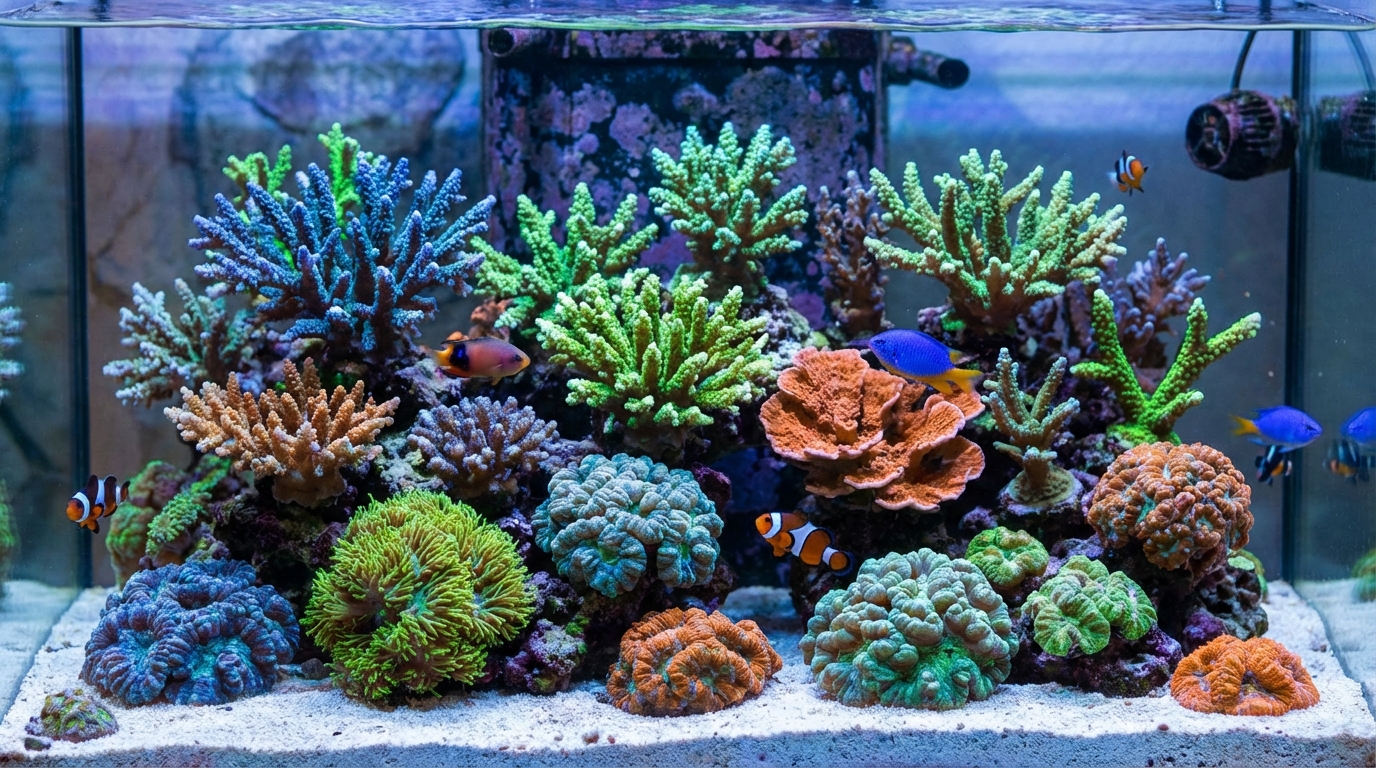
Start with the right gear
Build for consistency first. Prioritize reliable flow, heat, and filtration over flashy upgrades.
Cycle before livestock
Complete a full nitrogen cycle before adding fish or coral. Stability beats speed every time.
Starter targets
- Salinity: 1.025–1.026
- Temp: 77–79°F
- Alk: 7.5–9 dKH
Stock slowly
Start with hardy options like zoa and mushroom. Add livestock one at a time and observe for a week between additions.
Use the ReefBay app to track parameters and shop livestock with confidence.
Beginner Reef Setup: Full No-Guesswork Execution Plan
If you want your first reef tank to stay stable, think in phases instead of impulse purchases. Most beginner crashes happen when hobbyists add too much too soon, trust test strips without a baseline, or keep changing equipment settings every day. This expanded checklist gives you an operational plan you can follow from empty tank to first coral while keeping cost, risk, and stress under control.
Phase 1: Decide your tank style before you buy anything
Choose your system before checkout: all-in-one nano, rimless display with sump, or a used setup. Every style works, but each changes maintenance workload and upgrade options. A 20–40 gallon all-in-one is usually easiest for beginners because it limits plumbing mistakes while still giving enough water volume to buffer small errors. If you choose a very small tank, parameter swings happen faster. If you choose a larger tank, startup cost and water-change labor increase.
- Choose display location away from windows and HVAC vents.
- Confirm floor can support full tank weight with water and rock.
- Plan one dedicated power strip with drip loops.
- Decide whether your livestock focus is fish-heavy, coral-heavy, or mixed reef.
Phase 2: Build a realistic startup budget with buffers
New reefers usually budget for visible hardware and forget consumables. Add a 20–30% buffer for test kits, extra salt mix, filter socks/floss, replacement RO/DI filters, and emergency supplies. Budgeting correctly reduces panic purchases and lets you buy reliable essentials once instead of replacing cheap failures.
Typical starter categories include tank/stand, return and flow, heater/controller, lighting, filtration media, test kits, mixing equipment, quarantine supplies, and livestock. If you need equipment ideas, compare listings in the reef skimmer market, browse LED reef lighting, and review heater options before you lock in your first cart.
Phase 3: Aquascape for flow and maintenance access
Design rockwork with long-term cleaning in mind. Leave enough clearance around glass for magnetic cleaners, keep caves and swim-throughs open, and avoid unstable overhangs that can collapse when snails or urchins move underneath. Your aquascape should create both high-flow and lower-flow zones so you can place different coral types later without major rescapes.
- Use reef-safe epoxy or super glue gel to secure top-heavy pieces.
- Keep rock off glass to prevent dead zones and detritus traps.
- Aim powerheads to create random, intersecting flow patterns.
- Do a 24-hour leak and equipment test before adding saltwater livestock plans.
Phase 4: Cycle deliberately, not emotionally
The nitrogen cycle is where patience saves money. Feed the cycle with an ammonia source and monitor ammonia, nitrite, and nitrate until ammonia and nitrite consistently process to zero within 24 hours after dosing. Avoid adding fish “to test the cycle.” You are testing bacteria capacity, not fish tolerance for toxins.
During cycling, focus on consistency: stable salinity, stable temperature, and predictable top-off. Log every test and correction so you can spot trends. The ReefBay app is useful here because parameter history helps you avoid over-correcting after one odd result.
Phase 5: Build your first-90-day parameter guardrails
Beginners succeed when they run tight operating ranges and make small corrections. Set practical guardrails and only adjust one variable at a time. Chasing “perfect numbers” every day creates instability. Stability beats perfection in early systems.
- Salinity: 1.025–1.026 specific gravity
- Temperature: 77–79°F with minimal daily swing
- Alkalinity: 7.5–9 dKH
- Calcium: 400–460 ppm
- Magnesium: 1250–1400 ppm
- Nitrate: non-zero but controlled (commonly 2–20 ppm depending on system)
- Phosphate: detectable but managed (commonly 0.03–0.15 ppm depending on goals)
Phase 6: Stock fish in a low-risk order
Stocking sequence matters. Add the hardiest, least aggressive fish first, then evaluate feeding response, waste load, and behavior for at least one full week before adding the next fish. This protects your biofilter and reduces territory conflicts.
Great first-search categories include clownfish, goby, and blenny. Avoid adding multiple territorial fish together in week one. If aggression starts, change rock line-of-sight breaks before it escalates.
Phase 7: Add beginner corals with a placement map
Corals fail less when placement is planned around PAR and flow from day one. Start with hardy species and place frags where you can observe extension, tissue response, and feeding behavior easily. Beginner-friendly options like zoa, mushroom, and toadstool are forgiving but still need stable salinity and temperature.
- Dip and inspect all new coral frags before introduction.
- Start lower in the tank and move upward gradually if needed.
- Leave growth spacing so corals do not sting each other later.
- Photograph each coral weekly to catch slow decline early.
Phase 8: Create a maintenance cadence you can actually keep
Success comes from repeatable habits, not heroic weekend rescues. Build a routine that fits your schedule and stick to it.
- Daily: check temperature, ATO function, and livestock behavior.
- 2–3x/week: test salinity and alkalinity in young systems.
- Weekly: clean glass, empty skimmer cup, inspect pumps, test key nutrients.
- Biweekly: water change, mechanical media replacement, detritus siphon where needed.
- Monthly: deep-clean pumps/powerheads and verify heater calibration.
Phase 9: Prevent the five beginner crash patterns
- Overfeeding: raises nutrients fast; feed smaller portions and observe full consumption.
- Overstocking: increases bio-load before bacteria catch up; space additions.
- Overcorrecting: rapid dosing swings stress corals; make small measured adjustments.
- Ignoring equipment drift: failing heaters/pumps cause sudden instability; inspect routinely.
- Skipping quarantine/dips: pests and disease are expensive; preventive steps are cheaper than treatment.
Phase 10: Build your emergency kit before you need it
Prepare for common failures now: heater malfunction, salinity drift, power outage, and stuck pumps. Keep pre-mixed saltwater, spare heater, battery air pump, and calibration fluid on hand. Write a one-page emergency checklist and store it near your tank so anyone at home can respond quickly.
When to upgrade equipment (and when not to)
Upgrade when current gear limits stability or creates excessive maintenance, not because social media says “must have.” A predictable, modest setup outperforms a complex setup that is tuned constantly. Prioritize upgrades that lower risk first: reliable ATO, quieter/more consistent flow, and test kit quality.
30-day execution checklist recap
- Day 1–3: leak test, aquascape stability, baseline mixing workflow.
- Day 4–20: full cycle monitoring with documented tests.
- Day 21–30: first fish addition, feeding controls, maintenance rhythm.
- Post-day-30: first hardy corals after stable trend confirmation.
Want to simplify buying and tracking? Browse live listings in the ReefBay marketplace and use the ReefBay app to track parameters, compare livestock options, and plan each next addition with less guesswork.
Advanced Beginner Checklist: Weeks 5–12
After your first month, the goal shifts from "survive" to "stabilize and scale carefully." Weeks 5–12 are where many tanks either settle into predictable growth or drift into recurring problems. Use this operating checklist to keep momentum without introducing instability.
Weekly operational review
Run one focused review block each week: compare parameter trends, inspect equipment wear, verify feeding discipline, and evaluate livestock behavior. Do not add new livestock the same week you make major equipment changes. Separate changes so cause-and-effect remains clear.
- Review salinity drift and ATO consistency.
- Compare alkalinity trend, not one isolated test.
- Inspect pumps for reduced output and noise changes.
- Check coral extension and tissue recession early signs.
- Clean sensor probes and verify thermometer accuracy.
Feeding economics and nutrient control
Feeding is both a husbandry and budget lever. Overfeeding increases food spend and nutrient-control media usage, then drives reactive water changes. Underfeeding weakens fish and slows coral recovery. Set a baseline feeding schedule and adjust based on observed consumption within two minutes.
Use small-portion dosing and alternate frozen/dry foods for consistency. If nutrients climb, first reduce excess input and improve export routine before buying additional chemical media.
Coral placement optimization routine
As corals adapt, reassess placement every 2–3 weeks. Some frags need incremental movement for better flow or light. Make one placement change at a time and monitor for a full week. Label frags and take top-down photos to detect subtle color and polyp changes that are easy to miss daily.
Simple decision tree when parameters drift
- Confirm measurement: retest and validate instrument calibration.
- Check root cause: evaporation, dosing inconsistency, feeding spike, or equipment drift.
- Apply small correction: avoid large single-step changes.
- Observe 24–72 hours: only then decide next action.
This approach prevents cascade errors caused by multiple rapid corrections.
Beginner-friendly expansion plan
When adding new livestock, keep your system load increase small and deliberate. For each addition, define expected impact on feeding, waste, and flow behavior. If any variable becomes unstable, pause additions immediately and return to baseline operations.
- One fish addition at a time, then one-week observation.
- 1–2 coral frags per cycle with spacing for future growth.
- Use dips and inspections to avoid importing pests.
- Add cleanup crew only as needed, not as a default reaction.
Inventory control for consumables
Create a minimum-stock level for salt mix, test reagents, filter media, and RO/DI replacements. Running out of essentials during an issue forces rushed decisions and expensive emergency orders. Keep a small but reliable shelf stock so maintenance cadence never breaks.
Maintenance tasks most beginners skip (and regret)
- Powerhead vinegar soaks to restore flow output.
- Return pump impeller inspection for wear/debris.
- Heater function verification against an external thermometer.
- Tubing and check-valve inspection for salt creep and blockages.
- ATO reservoir sanitation to prevent slime buildup.
90-day success metrics
By day 90, you should see tighter parameter ranges, lower correction frequency, and predictable livestock feeding response. If you still feel like you are firefighting every week, reduce system complexity: fewer changes, fewer additives, and stricter maintenance cadence.
For ongoing growth, use ReefBay shop to source planned additions instead of impulse buys and track all changes in the ReefBay app so decisions are based on trend data, not guesswork.
Troubleshooting Playbook for New Reef Tanks
When something goes wrong, avoid changing multiple variables at once. Use this quick-response playbook to diagnose efficiently:
Cloudy water
Check recent feeding, bacterial additives, and mechanical filtration status. Replace clogged floss, improve circulation, and avoid overreacting with large chemical changes unless livestock stress is visible.
Brown film algae phase
Common in young systems. Improve maintenance consistency, verify source water quality, and maintain stable nutrient export. Avoid aggressive chemical interventions unless the bloom persists beyond normal maturation windows.
Coral staying closed
Confirm salinity and alkalinity first, then inspect flow intensity and recent placement changes. Many beginner coral issues are stress responses to sudden changes, not immediate disease.
Fish aggression after additions
Rearrange line-of-sight in rockwork, use feeding distractions, and stage additions more slowly. Aggression frequently appears when multiple territorial fish are added too close together.
Slow growth frustration
New reefs need biological maturity. Focus on consistency, not constant tweaking. Growth usually follows stable trends in alkalinity, temperature, and nutrient balance over weeks—not days.
Use this playbook with your maintenance log in the ReefBay app, and source planned equipment/livestock additions through the ReefBay shop to keep decisions consistent and low-risk.
Supplier and Purchase Timing Checklist
Buying in the right sequence prevents wasted spend. Acquire maintenance consumables before livestock, and avoid scheduling deliveries when you cannot acclimate immediately. Always confirm you have dip supplies, matching salinity water, and time for observation before unpacking new arrivals. If any of those are missing, delay the order. This simple discipline prevents many beginner losses and keeps growth controlled.
For livestock days, plan a “quiet tank window”: no major cleaning, no new dosing routine, and no equipment swaps in the 48 hours around introduction. Keeping variables stable improves acclimation success and protects your investment.