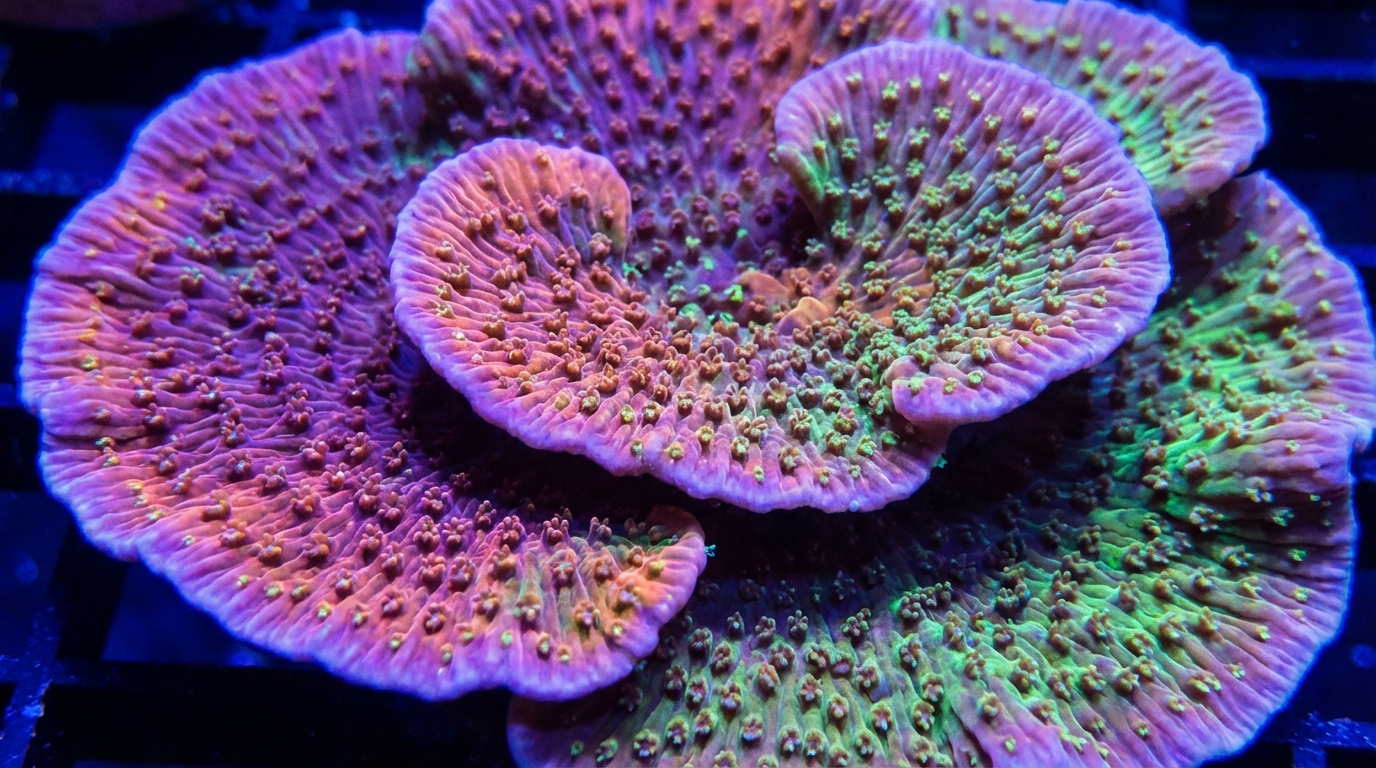
Want to move into SPS without jumping straight into ultra-sensitive Acropora? Montipora is one of the best next-step corals. This guide gives you practical targets for lighting, flow, and water chemistry so you can keep Montipora frags alive, colorful, and steadily growing.
For deeper SPS planning, also read our Acropora care guide and reef dosing guide.
What Makes Montipora Special
Montipora is one of the largest genera of reef-building corals, with over 80 described species. In the aquarium trade, they're prized for several characteristics:
- Growth diversity - Montiporas come in plating, encrusting, branching, and digitate forms
- Color variety - From rainbow multis to deep purples, greens, oranges, and reds
- Faster growth - Many species grow faster than Acropora
- Greater tolerance - More forgiving of parameter swings than many SPS
- Small polyps - Create smooth, velvety textures when extended
Popular Montipora Varieties
Several Montipora varieties have become staples in the hobby:
Montipora capricornis (Monti Cap)
The classic plating Montipora that grows in distinctive whorled patterns. Available in green, purple, orange, red, and rainbow varieties. These make dramatic centerpiece corals as they grow larger.
Montipora digitata
A branching variety that forms finger-like projections. Green and purple digitatas are especially popular and can create impressive colonies relatively quickly.
Montipora spongodes
An encrusting species that spreads across rockwork. Forest fire and rainbow varieties are highly sought after.
Montipora setosa
Features distinctive "fuzzy" polyps that extend during feeding. Creates beautiful texture in any reef.
Water Parameters for Montipora
Like all SPS corals, Montiporas require stable water chemistry. Here are the ideal parameters:
- Temperature: 76-79°F (24-26°C)
- Salinity: 1.025-1.026 specific gravity
- pH: 8.1-8.4
- Alkalinity: 8-9 dKH (most critical parameter)
- Calcium: 420-440 ppm
- Magnesium: 1350-1450 ppm
- Phosphate: 0.03-0.1 ppm
- Nitrate: 2-10 ppm
Pro tip: Stability is more important than hitting perfect numbers. Montiporas handle a range of parameters better than rapid fluctuations. Use the ReefBay app to track your parameters and spot trends before they become problems.
Lighting Requirements
Montipora corals are photosynthetic and rely heavily on quality reef lighting:
PAR Requirements
- Minimum: 150-200 PAR
- Optimal: 250-400 PAR
- Maximum: 500+ PAR (for adapted specimens)
Spectrum
Montiporas display best under blue-heavy lighting (15,000-20,000K appearance). Many reefers run 70-80% blue spectrum. However, full spectrum with adequate blue and some white/red wavelengths promotes better growth and coloration.
Photoperiod
A standard 8-10 hour photoperiod works well. Ramp lights up and down gradually over 1-2 hours to simulate natural conditions.
Flow Requirements
Proper water movement is essential for Montipora health:
- Flow type: Random, chaotic flow (not laminar)
- Flow strength: Moderate to high
- Goal: Polyps should gently sway without being blasted flat
Good flow helps Montiporas in several ways:
- Delivers food and nutrients
- Removes waste and detritus
- Prevents algae and sediment buildup
- Aids in gas exchange
Consider using a wavemaker or powerhead to create variable flow patterns in your reef.
Placement and Positioning
Where you place your Montipora significantly impacts its health and growth:
General Guidelines
- Plating varieties (capricornis): Mid-tank to upper-mid, angled to maximize light capture on the plate surface
- Branching varieties (digitata): Mid to upper tank positions
- Encrusting varieties: Can be placed on rockwork at various heights
Acclimation
Always acclimate new Montiporas to your lighting:
- Start the coral lower in the tank or reduce lighting intensity
- Over 2-4 weeks, gradually move it to its final position
- Watch for signs of stress (bleaching, tissue recession)
Spacing
Montiporas can be aggressive toward other corals. Leave at least 2-3 inches between Montiporas and neighboring corals. Plating varieties will overgrow anything beneath them as they expand.
Feeding Montipora
While Montiporas get most of their nutrition from photosynthesis, supplemental feeding can boost growth and coloration:
What to Feed
- Coral foods (amino acids, zooplankton)
- Phytoplankton
- Reef Roids or similar coral foods
- Broadcast feeding works well due to small polyp size
Feeding Frequency
Feed 1-3 times per week. Some reefers don't target feed Montiporas at all and rely on fish waste and natural food sources in the water column.
Common Montipora Problems
Montipora Eating Nudibranchs
These small white or cream-colored nudibranchs are devastating pests. Signs include:
- White circular marks on tissue
- Exposed skeleton patches
- Tiny egg spirals on coral or nearby surfaces
Treatment: Quarantine affected corals, dip in coral pest dip, and manually remove nudibranchs. Wrasses like six-line or melanurus can help prevent infestations.
STN/RTN (Slow/Rapid Tissue Necrosis)
Tissue recession that exposes white skeleton. Causes include:
- Alkalinity swings (most common)
- Temperature fluctuations
- Poor water quality
- Bacterial infections
Treatment: Stabilize parameters, improve water quality, and consider fragging ahead of recession to save healthy tissue.
Browning Out
Loss of vibrant colors, coral turns brown. Usually caused by:
- Too much nutrients (elevated nitrates/phosphates)
- Insufficient lighting
- Wrong spectrum
Treatment: Optimize lighting and gradually reduce nutrients through water changes and improved filtration.
Bleaching
Coral turns pale or white (zooxanthellae loss). Causes:
- Too much light (photo-shock)
- Temperature stress
- Chemical contamination
Treatment: Reduce lighting, stabilize temperature, run activated carbon. Some corals can recover if stress is removed promptly.
Fragging Montipora
Montiporas are among the easiest SPS corals to frag:
Plating Varieties
- Use bone cutters or a bandsaw to cut sections
- Aim for 1-2 inch pieces minimum
- Glue to frag plugs or rock rubble
Branching Varieties
- Snip branches with bone cutters
- Cut at branch points for cleaner breaks
- Mount vertically on frag plugs
Encrusting Varieties
- Use a chisel or dremel to separate sections from rock
- Can also place rubble next to coral and let it encrust over
After fragging, return coral to optimal conditions and monitor for infection. Dipping in iodine or coral dip can help prevent bacterial issues.
Montipora vs Acropora: Key Differences
Many reefers wonder whether to start with Montipora or Acropora. Here's how they compare:
- Difficulty: Montipora generally easier (more forgiving)
- Growth rate: Montipora often grows faster
- Parameter sensitivity: Acropora more demanding
- Lighting needs: Similar, both need strong light
- Price: Montipora typically more affordable
- Pest issues: Both susceptible to different pests
If you're new to SPS, start with hardy Montipora varieties like green digitata or purple cap before graduating to Acropora.
Building a Montipora Collection
When shopping for Montipora, look for:
- Good polyp extension in seller photos
- No white patches or tissue recession
- Bright, consistent coloration
- WYSIWYG (What You See Is What You Get) listings when possible
Start with hardier varieties and work your way up to more demanding specimens as you gain experience.
Conclusion
Montipora corals offer the perfect gateway into the world of SPS keeping. With proper water chemistry, adequate lighting, and stable parameters, these stunning corals will reward you with vibrant colors and satisfying growth. Whether you choose a dramatic plating cap or a forest of branching digitata, Montiporas can become the centerpiece of any reef aquarium.
Ready to stock your first or next Monti? Shop Montipora listings, compare seller photos, and build a stable plan with the ReefBay app so alkalinity, calcium, and magnesium stay on track.