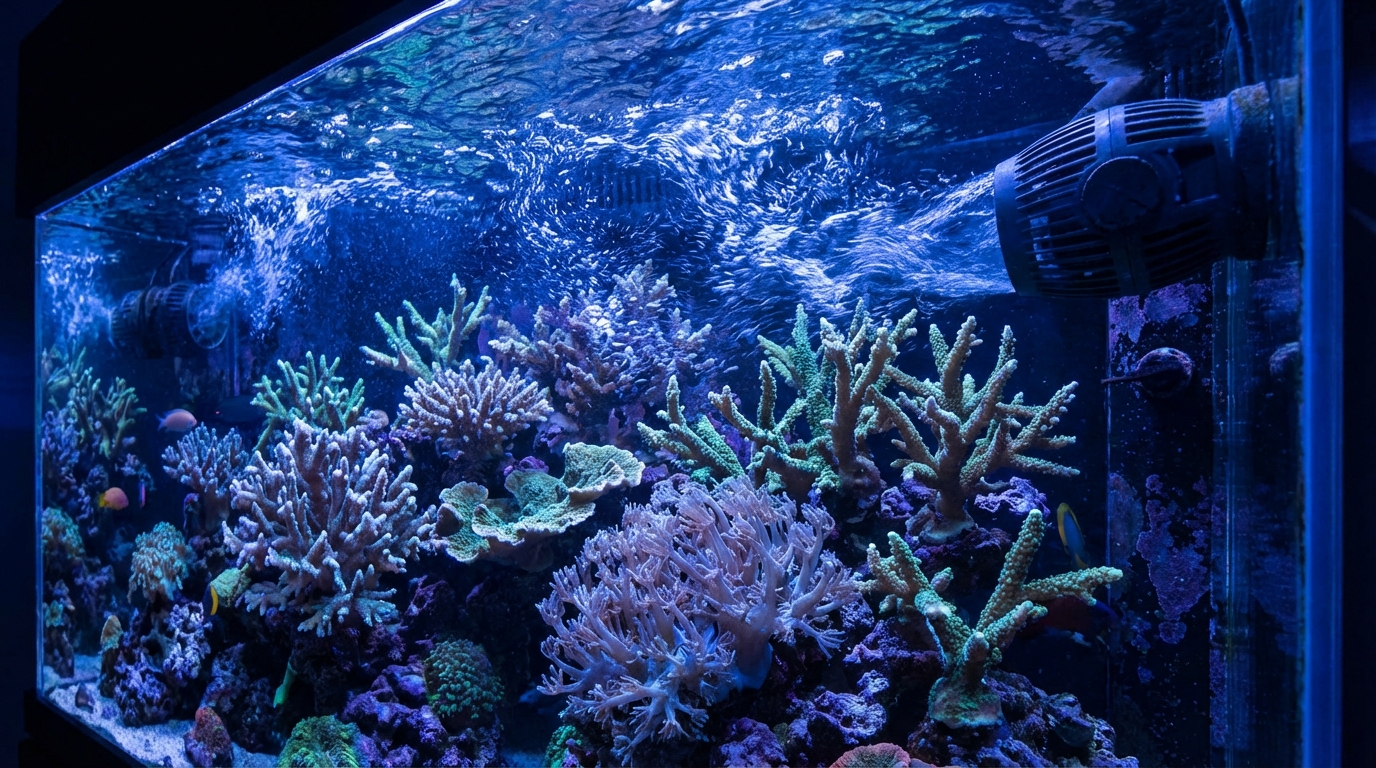
Water flow might be the most underappreciated element of reef tank success. While lighting and chemistry dominate discussions, proper circulation quietly determines whether your corals merely survive or truly thrive. Good flow delivers food and nutrients to coral polyps, carries away waste products, prevents harmful bacterial buildup, and mimics the ocean environment corals evolved in.
This guide covers everything you need to know about reef tank flow - from understanding different types of water movement to choosing equipment and positioning it correctly for your specific setup.
Why Flow Matters in Reef Aquariums
In the wild, corals experience tremendous water movement from waves, currents, and tides. This constant motion serves critical functions that we need to replicate:
Nutrient and Food Delivery
Coral polyps are stationary filter feeders. They rely on water movement to bring them microscopic food particles, copepods, and dissolved nutrients. Without adequate flow, corals essentially starve even in nutrient-rich water.
Waste Removal
Corals excrete waste and mucus that must be carried away. Stagnant water allows this waste to accumulate, creating ideal conditions for bacterial infections and tissue necrosis. Flow also prevents detritus from settling on coral tissue, which can smother polyps.
Gas Exchange
Moving water improves oxygen and carbon dioxide exchange at the coral surface. This supports both the coral animal and its symbiotic zooxanthellae algae, which need CO2 for photosynthesis.
Coral Growth and Structure
Flow physically shapes coral colonies. SPS corals in high-flow environments develop thicker, more robust skeletons. Insufficient flow often results in long, spindly branches prone to breaking.
Types of Flow Devices
Modern reef tanks use several types of circulation equipment, each with distinct characteristics:
Traditional Powerheads
Powerheads are the workhorses of reef circulation. They use propeller-driven pumps to push water in a focused stream.
- Pros: Affordable, reliable, easy to position, widely available
- Cons: Create narrow, laminar flow; multiple units often needed
- Best for: Supplemental flow, specific target areas, budget builds
Wavemakers
Wavemakers are essentially powerheads with built-in controllers that vary the output. They create more natural, pulsing flow patterns that better simulate ocean conditions.
- Pros: Variable flow patterns, more natural movement, programmable
- Cons: More expensive than basic powerheads
- Best for: Mixed reef tanks, LPS heavy systems, natural biotopes
Gyre Pumps
Gyres create wide, sheet-like flow patterns across the entire tank rather than focused streams. They excel at generating tank-wide circulation patterns.
- Pros: Wide flow pattern, efficient tank-wide circulation, fewer dead spots
- Cons: More expensive, specific placement requirements
- Best for: SPS-dominant tanks, larger aquariums, advanced setups
Return Pump Flow
Your sump return pump contributes to overall circulation. While not its primary purpose, a properly directed return adds to total turnover. Consider adjustable or rotating return nozzles to maximize benefit.
How Much Flow Do You Need?
Total flow is typically measured in tank turnover rate - how many times per hour the entire water volume cycles through your pumps.
General Guidelines
- Soft coral tanks: 20-30x turnover
- LPS tanks: 30-40x turnover
- Mixed reef: 40-50x turnover
- SPS-dominant tanks: 50-100x turnover or higher
Calculating Your Flow
Add up the GPH (gallons per hour) ratings of all your circulation pumps, then divide by your tank volume:
Example: Two 1,500 GPH powerheads + 800 GPH return = 3,800 GPH total
100 gallon tank: 3,800 ÷ 100 = 38x turnover
Note: Actual flow is always less than rated flow due to head pressure, age, and biological growth. Assume 70-80% of rated capacity for planning.
Flow Requirements by Coral Type
Different corals have evolved for different flow environments. Matching flow to your livestock is essential.
High Flow Corals (50+ turnover)
- Acropora - Thrive in strong, turbulent flow
- Montipora - Appreciate moderate to high random flow
- Pocillopora - Do well in strong, consistent flow
- Stylophora - Handle high flow excellently
Moderate Flow Corals (30-50x turnover)
- Hammer corals - Need flow to extend tentacles but not too strong
- Torch corals - Moderate, indirect flow works best
- Frogspawn - Similar to torch preferences
- Blastomussa - Moderate flow prevents detritus buildup
Low Flow Corals (20-30x turnover)
- Acan corals - Too much flow damages fleshy polyps
- Duncan corals - Gentle flow allows full polyp extension
- Mushroom corals - Can detach with excessive flow
- Brain corals - Prefer calmer water
Track your coral health and flow requirements with the ReefBay app to find the sweet spot for your specific tank.
Powerhead Placement Strategies
Positioning flow devices correctly is often more important than raw flow power. Poor placement creates dead spots and excessive direct flow simultaneously.
The Cross-Flow Pattern
Position two powerheads on opposite ends of the tank, pointed toward each other. The colliding currents create chaotic, random flow in the center - perfect for SPS corals.
The Gyre Pattern
Place all flow devices on one side of the tank, pointed in the same direction. Water circulates around the entire tank in a rotating pattern. Excellent for reducing dead spots.
The Indirect Approach
Aim powerheads at rock or glass so flow bounces before reaching corals. Creates gentler, diffused patterns ideal for LPS and soft corals.
Avoiding Common Mistakes
- Don't point directly at corals: Constant direct blast damages tissue
- Watch for sand-blowing: Adjust angle to avoid excavating substrate
- Eliminate dead spots: Feel for areas with no current and add supplemental flow
- Consider coral placement: Position high-flow corals near pumps, low-flow corals in calmer zones
Random vs Constant Flow
Modern controllers allow switching between constant flow and random/wave patterns. Each has advantages:
Constant Flow Benefits
- Predictable and easy to plan coral placement
- Effective at preventing dead spots when well-positioned
- Simpler equipment requirements
Random/Wave Flow Benefits
- More closely mimics ocean conditions
- Corals experience varied intensity, promoting thicker growth
- Better nutrient distribution throughout water column
- Detritus stays suspended longer for filtration removal
Most experienced reefers recommend random or alternating patterns when possible. Even basic wavemakers with simple on/off cycles outperform constant flow for coral health.
Signs of Flow Problems
Your corals will tell you when flow isn't right. Learn to read these signs:
Too Much Flow
- Coral polyps stay retracted
- Tissue pulling away from skeleton (especially LPS)
- Coral leaning or growing away from flow source
- Frags constantly falling over
- Sand constantly disturbed
Too Little Flow
- Detritus accumulating on coral surfaces
- Cyano or algae growing in specific areas
- Coral tissue looking stretched or elongated
- Brown jelly disease or other infections
- Mulm buildup in corners and behind rocks
Flow and Coral Feeding
Adjust flow during feeding for best results:
- Turn off pumps briefly when target feeding LPS corals - lets food settle on polyps
- Maintain flow when broadcast feeding - distributes food throughout tank
- Resume normal flow after 15-20 minutes to prevent water quality issues
Many wavemaker controllers include a "feed mode" that reduces or stops flow for a preset time.
Equipment Maintenance
Flow devices require regular maintenance to perform optimally:
Monthly Tasks
- Check flow output - reduction indicates cleaning needed
- Inspect impeller for debris or damage
- Clean intake screens and guards
- Verify mounting is secure
Quarterly Deep Clean
- Soak pumps in vinegar solution (1:1 with water) for 2-4 hours
- Scrub away calcium buildup with brush
- Clean magnets and mounting systems
- Check cord integrity
Neglected powerheads can lose 30-50% of their rated flow within months. Regular maintenance keeps your investment working properly.
Choosing Flow Equipment
Consider these factors when selecting powerheads and wavemakers:
Key Selection Criteria
- Tank size: Match GPH rating to your turnover goals
- Coral type: SPS tanks benefit from gyres; mixed reefs need adjustable flow
- Controllability: Wavemakers with programming offer most flexibility
- Noise level: Important for living spaces
- Reliability: Check reviews for longevity
- Energy efficiency: DC pumps typically use less power
Conclusion
Proper water flow transforms a reef tank from a survival environment into a thriving ecosystem. It's one of the few aspects of reefkeeping where getting it right costs relatively little but pays enormous dividends in coral health and growth.
Start with the guidelines in this guide, then observe your corals and adjust. Every tank is unique - what works in one setup may need tweaking in another. Use the ReefBay app to track which changes help your corals, and browse the marketplace to find quality flow equipment from trusted sellers.